March 2020 is the month reality stopped negotiating with the feed.
For years, the internet has trained us to experience the world as a series of short bursts. A headline. A clip. A reaction. A dunk. Then the next thing. The tempo is fast, the emotions are loud, and the consequences are usually abstract enough that you can scroll away without feeling them.
A pandemic does not let you scroll away.

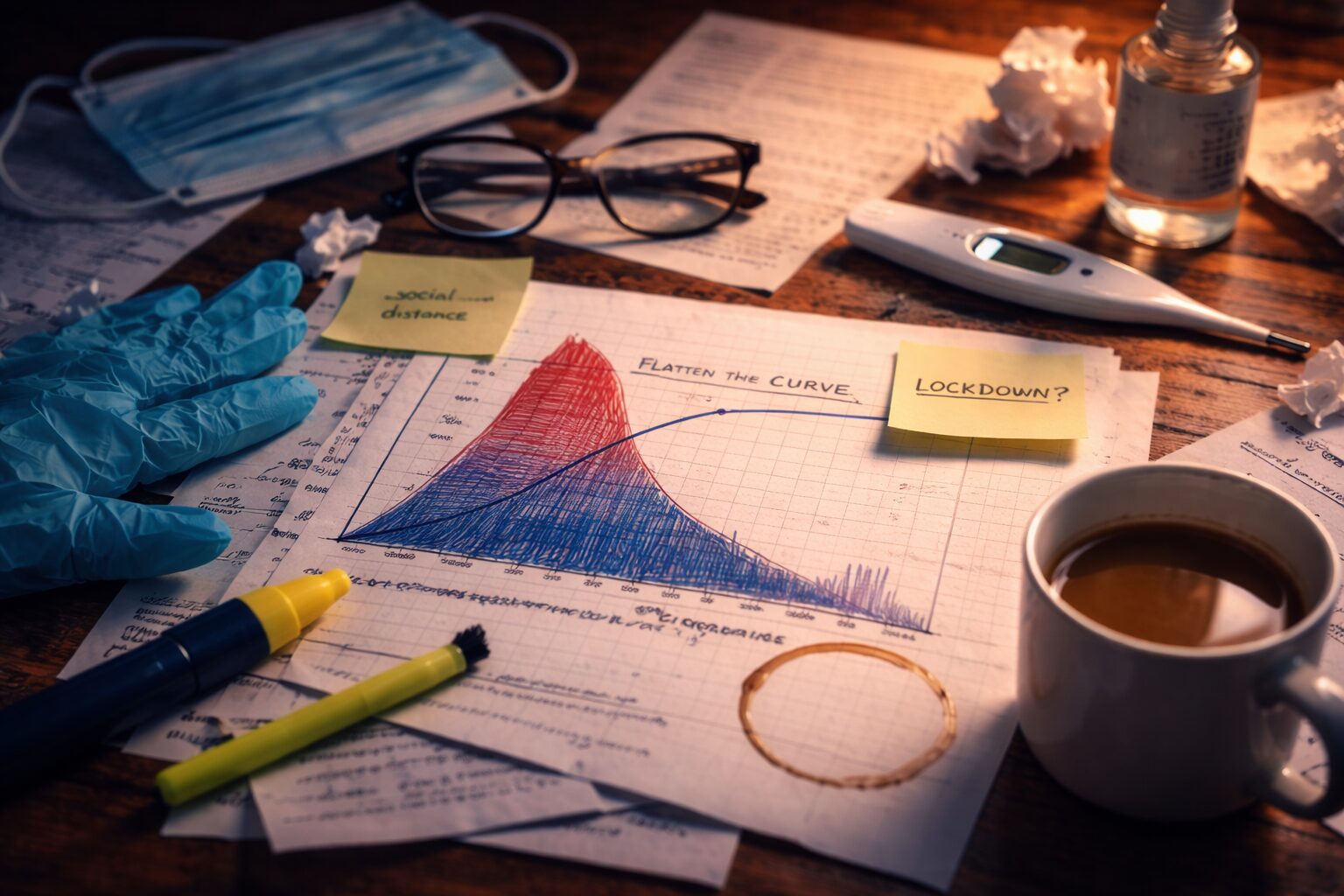
It takes the soft, endless arguments of political life and replaces them with something brutal and measurable. A curve. A hospital capacity chart. A timeline that does not care whether you feel offended by it. For the first time in a long time, the world is forcing the country to learn something that the attention economy hates.
Scale.
The curve is not a metaphor
We are surrounded by people treating the curve like a rhetorical device. Like a symbol you can wield in an argument. Like a graph that exists to embarrass your opponents. Like a talking point to be deployed.
It is not.
The curve is an accounting of bodies and time. It is the shape of contagion and contact. It is the answer to a question the feed never asks: how many consequences can happen at once.
This is why public health messaging feels so strange to an internet-trained brain. It demands patience. It demands restraint. It asks you to do nothing, deliberately, for the sake of people you will never meet. It asks you to accept that your individual story is not the point.
The curve is not content. It is math.
The clip is still winning
And yet, the clip persists.
Even as hospitals brace, the machine keeps doing what it does. It turns complicated realities into short, shareable performances. It rewards the politician who says the strongest thing, not the truest thing. It rewards the pundit who can weaponize fear into certainty. It rewards the person who can point at a clip and declare victory.
This is the central problem of March 2020. We are trying to solve a public health crisis using an information system optimized for entertainment.
Entertainment does not like humility. It does not like uncertainty. It does not like slow explanation. It does not like, “We don’t know yet.” It likes villains. It likes heroes. It likes simple narratives with a clear ending.
A pandemic is not a narrative with a neat ending. It is a long, boring discipline punctuated by tragedy.
The machine is not built for that.
The click is a coping mechanism
In a moment of fear, people reach for what is familiar. In March, what is familiar is the click.
Refreshing the feed feels like control. Posting feels like participation. Sharing feels like warning your friends. Declaring certainty feels like stability. Finding a villain feels like focus.
But the click does not solve the problem. It often makes it worse.
Because the click is not neutral. It selects for the most emotionally satisfying version of events. It favors the story that makes you feel smart, not the story that makes you act wisely. It turns the crisis into a moral theatre where the performance of caring becomes more important than the behavior that actually protects people.
This is how you get a culture where outrage is abundant and masks are scarce.
The pandemic and the politics of identity
There is an old American reflex that says everything must be turned into a tribal signal. Not because everything is political in the deep sense, but because everything is marketable as politics in the shallow sense.
So even a virus becomes a jersey.
Public health guidance becomes a personality test. Precaution becomes a sign of weakness to one tribe and a sign of virtue to another. Skepticism becomes courage to one side and ignorance to the other. Every behavior gets assigned a moral identity.
This is why the messaging is chaotic. Not only because the science evolves, but because the audience has been trained to interpret guidance as allegiance.
A pandemic does not care about your allegiance. It cares about contact.
But the attention economy is addicted to allegiance, because allegiance is sticky. It keeps you checking. It keeps you defending. It keeps you posting.
The death of the middle
In a sane information environment, there would be a middle space between panic and denial. A space for uncertainty, for partial knowledge, for evolving guidance, for the honest admission that people are trying to do their best with incomplete information.
That middle space is disappearing.
The machine hates the middle. The middle is slow. The middle is cautious. The middle doesn’t generate a satisfying clip. So the culture splits into two postures, each emotionally clean and intellectually lazy.
Total panic, and total dismissal.
Both are forms of coping. Neither is leadership.
The truth is uglier. The truth is that the virus is real, the tradeoffs are brutal, and the answers are imperfect. The truth is that we need competence, not performance. The truth is that you can be scared and still be rational.
But the feed is not a place where rational fear thrives. It is a place where fear is monetized.
A new kind of civic literacy
If March 2020 is going to teach us anything, it should be this. The ability to read information is now a survival skill.
Not just reading words, but reading incentives. Reading what the platform rewards. Reading what a politician gains by telling you one version of the story instead of another. Reading whether a clip is designed to inform you or to recruit you.
This is a kind of literacy we were never taught. We were taught to spot a lie. We were not taught to spot a distortion that is technically true but functionally misleading. We were not taught to spot content designed to make us feel a certain way so we will share it.
But now we have to learn, fast.
Because misinformation in March 2020 is not just a civic problem. It is a public health problem.
After March
This crisis will pass, eventually. But the information system that shaped how we experienced it will remain.

The question is what we learn about ourselves in the process.
Do we learn that attention is not the same as action. That performing concern is not the same as practicing restraint. That sharing a clip is not the same as protecting a neighbor.
Or do we learn the opposite. Do we let the machine teach us that the crisis was just another content cycle, another moment to posture, another opportunity to dunk, another chance to reinforce tribal identity.
The curve is real. The stakes are real. The suffering is real.
The question is whether we can build an information culture that treats reality as more important than performance.
Because if we can’t, the next crisis will not just hurt us.
It will entertain us while it does.
Leave a Reply