
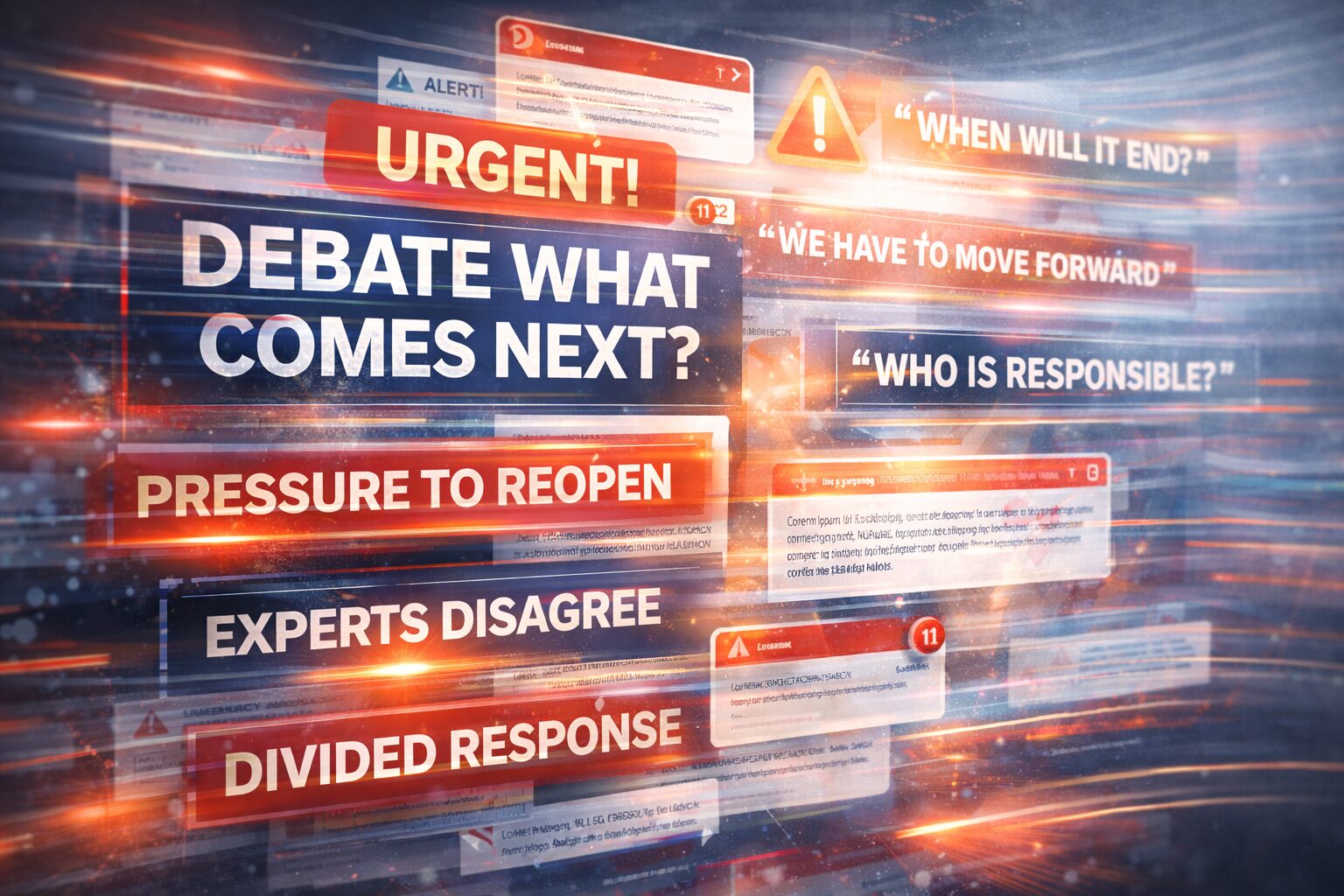
The emergency phase is ending, but nothing feels resolved
By May, the shock has dulled. The days are no longer defined by discovery alone. Routines have formed, even if they are fragile ones. The language of crisis remains, but it now competes with the language of endurance.
Attention begins to shift from what is happening to how long this can last.
This is not relief. It is a different kind of pressure.
The debate turns forward prematurely
Conversations move quickly to reopening, restarting, returning. These words circulate with confidence, even as their meanings remain unclear. They suggest control, sequencing, and planning, though none of those are fully present.
The future becomes a political object before the present has stabilized.
There is impatience with uncertainty, and that impatience shapes policy as much as data does.
Solidarity starts to fracture into categories
Early appeals to collective responsibility still exist, but they are increasingly conditional. Essential versus non-essential. Safe versus unsafe. Responsible versus reckless.
These distinctions harden into identities.
What began as shared sacrifice is now filtered through risk tolerance, economic exposure, and political affiliation. Agreement narrows. Suspicion grows.
The question shifts from what should we do to who is being asked to do it.
Expertise is still central, but no longer singular
Scientific guidance remains prominent, but it is no longer perceived as unified. Models diverge. Recommendations vary. Timelines slip.
This does not diminish expertise, but it complicates it.
Public trust now requires interpretation, not just authority. And interpretation is inherently political.
The absence of an endpoint becomes its own problem
Without a clear conclusion, the situation is increasingly judged by comparison rather than outcome. Regions look sideways at one another. Countries measure themselves against peers. Progress is framed relatively, not absolutely.
This produces competition where coordination might otherwise exist.
The lack of a finish line turns every decision into a provisional one, vulnerable to reversal or backlash.
Normal is invoked, but not defined
“Normal” appears frequently in speeches and commentary, often paired with “new.” The phrase reassures without specifying what is being restored, and what is being abandoned.
It functions as a promise rather than a plan.
The risk is not that normal will return unchanged, but that it will be selectively remembered.
A quieter, harder phase
May is not marked by sirens or sudden closures. It is marked by negotiation, compromise, and disagreement about direction.
The crisis has moved from interruption to integration.
What comes next is not determined by emergency response alone, but by choices made under fatigue, pressure, and incomplete information.
Those choices are already being argued over.
Leave a Reply