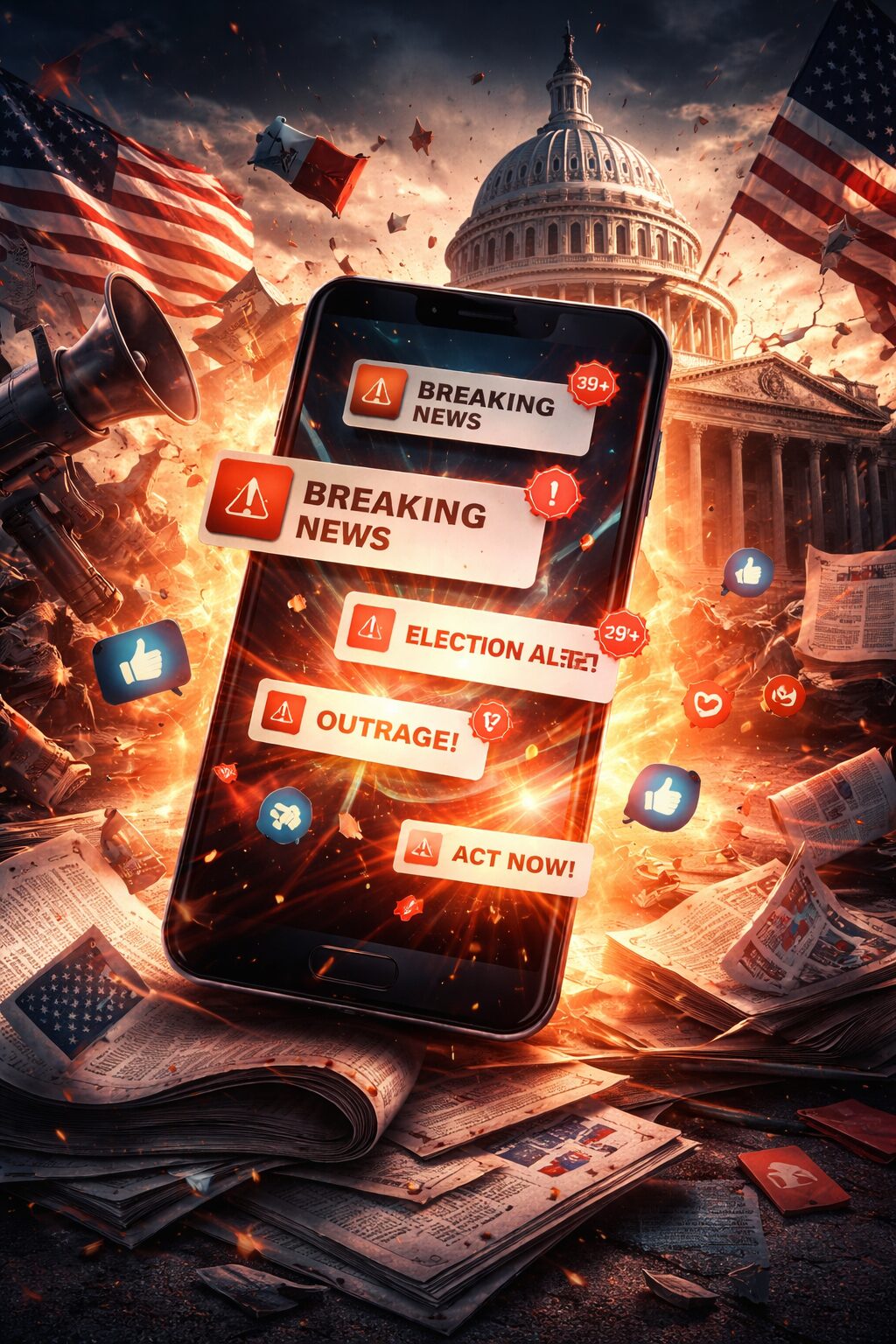
America doesn’t have a politics problem. It has a user-experience problem.
That sounds flippant until you notice how much of public life now behaves like a badly designed app. Every issue is a pop-up. Every scandal is a push alert. Every election is a “limited time offer.” And the entire country is stuck in a permanent onboarding flow where the rules keep changing and the terms of service are written by whoever shouts loudest.
If you feel tired, it’s not because you don’t care. It’s because the system is optimized to keep you caring, constantly, about everything, all at once, forever.
This is the part people miss when they talk about polarization as if it’s a natural weather pattern. Polarization is not just disagreement. It’s sustained attention. It’s the outcome of a machine that learned the difference between “informed” and “engaged” and chose the more profitable option.
The alert is the message
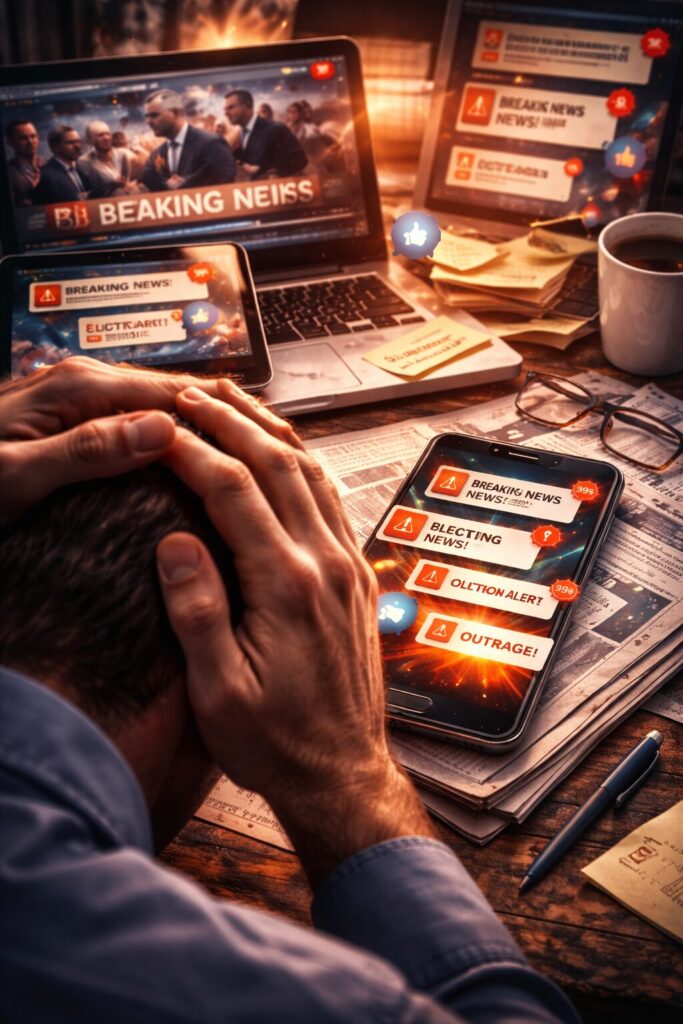
Remember when news had a rhythm. Morning paper, evening broadcast, a week of digestion after a big event. That world is gone. Now the news arrives the way a casino arrives, bright and loud and insistently present.
You don’t read politics anymore. Politics interrupts you.
It arrives while you’re in line for coffee. It arrives while you’re half-watching a show. It arrives while you’re trying to fall asleep. It arrives as a little red circle that says you are behind, you are missing something, you should catch up, you should feel something immediately.
And because the alert is designed to be clicked, the content is designed to be click-shaped. Not explained. Not contextualized. Click-shaped.
A headline that makes you curious is fine. A headline that makes you furious is better. A headline that makes you feel like you’re in danger is the jackpot.
So the country lives on edge. Not because reality is always on edge, but because the interface is.
Politics as microdosing
In an older political culture, people had opinions they revisited. Now many people have opinions they refresh.
The feed doesn’t give you time to develop a view. It gives you a series of emotional microdoses: a clip, a quote, a reaction, a counter-reaction. A quick hit of certainty. A quick hit of disgust. A quick hit of righteousness. Then another.
This changes what politics feels like. It’s not deliberation. It’s stimulation.
You can see it in the way people speak now, not just what they believe. The jump cuts. The slogans. The way arguments are built out of shared references instead of shared facts. The way someone can “win” a debate by producing the correct meme at the correct moment.
We are not having conversations. We are trading tokens.
And the tokens are designed to keep us in the game.
The collapse of “later”
Democracy requires the concept of later. Later is where you verify. Later is where you reflect. Later is where you discover you were wrong and adjust. Later is where you build coalitions, because coalitions take time and trust.
The attention economy hates later.
Later is bad for engagement. Later is quiet. Later is boring. Later is where you stop feeding the machine.
So the machine trains you to live in now. To treat every event as immediate and decisive. To interpret a half-formed story as a final verdict. To share first, process never. It trains you to confuse speed for seriousness.
This is why politics feels so brittle. Brittle is what happens when everything is urgent and nothing is stable.
The new virtue is visibility
One of the quieter shifts in the last few years is the way moral life has become public by default. In 2020, many people don’t just do good. They show good. They don’t just believe. They announce belief. They don’t just vote. They post the sticker.
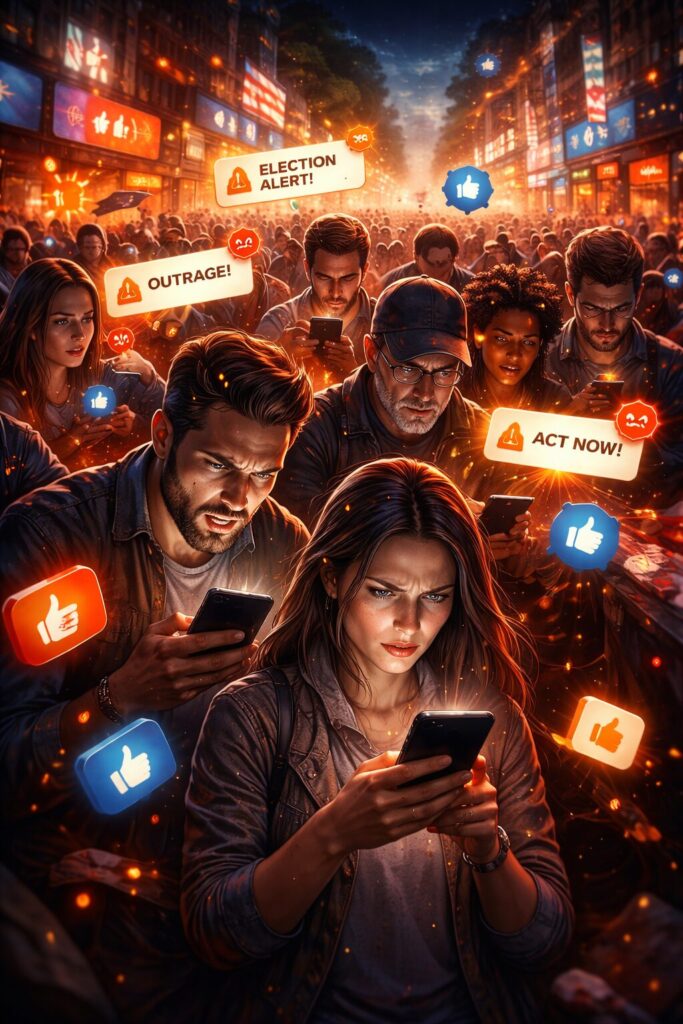
The problem isn’t that people care about values. Values matter. The problem is that the interface rewards visibility, not integrity. Visibility is easier to measure. It’s also easier to manipulate.
So the pressure is constant. Speak up. Post. Condemn. Support. Prove you’re on the right side. And if you don’t, the silence is interpreted as complicity. Everyone is forced into performance, and performance is always judged by the loudest people in the room.
This doesn’t produce better citizens. It produces anxious ones.
It produces people who are less interested in getting things right than in getting caught being wrong.
The politics of permanent agitation
A permanently agitated population is easy to steer.
When you are anxious, you prefer simple stories. When you are angry, you prefer clear enemies. When you are exhausted, you prefer certainty. The machine supplies all of that, on demand.
This is why “the other side” has become a character rather than a set of humans. Characters don’t require empathy. Characters don’t require nuance. Characters exist to be hated and defeated.
And if politics is a story about defeating villains, then the only thing that matters is the plot twist that keeps you watching.
That is not governance. That is content.
A small experiment
Try this. For one week, turn off push notifications for news and social apps. Not forever. Just a week.
Then notice what happens.
You will still learn what matters. The real world has a way of delivering important information. But you will learn it at human speed, not machine speed. You will have space to read more than a headline, to wait for confirmation, to absorb context, to develop an opinion that is yours and not an echo.
The goal is not ignorance. The goal is agency.
Because right now, a lot of people are mistaking their notification schedule for their civic duty.
What this costs
The cost of Notification Nation is not just that we’re tired. It’s that we become easier to manipulate. We become less patient, less curious, less capable of disagreement, less capable of coalition, less capable of later.
A democracy can survive disagreement. It cannot survive a citizenry that is permanently hacked.
If 2019 was the year the feed learned your triggers, 2020 is shaping up to be the year it automates them. Not because someone in a room is plotting against you, but because the incentives are blunt and relentless.
The machine does not care what you believe. It cares that you react.
The question is whether you can build a political life that isn’t dictated by a red badge icon.
Because if you can’t, the next election will not feel like a choice.
It will feel like a notification you were trained to click.
Leave a Reply