
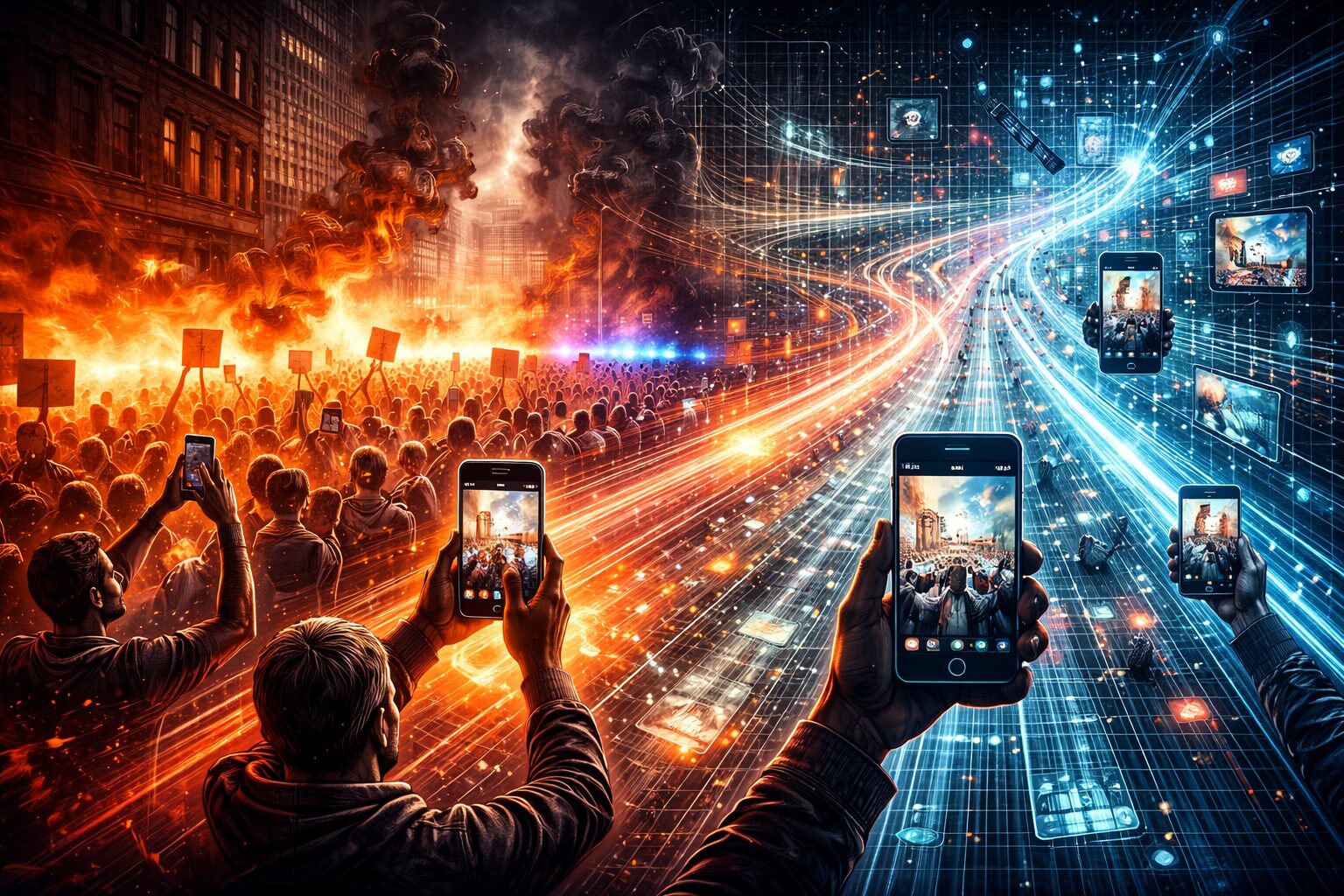
The street isn’t just a place anymore. It’s a data source.
The last decade trained us to think the internet is where politics happens. June is reversing that. Politics is happening in the street, and the internet is what gets built on top of it.
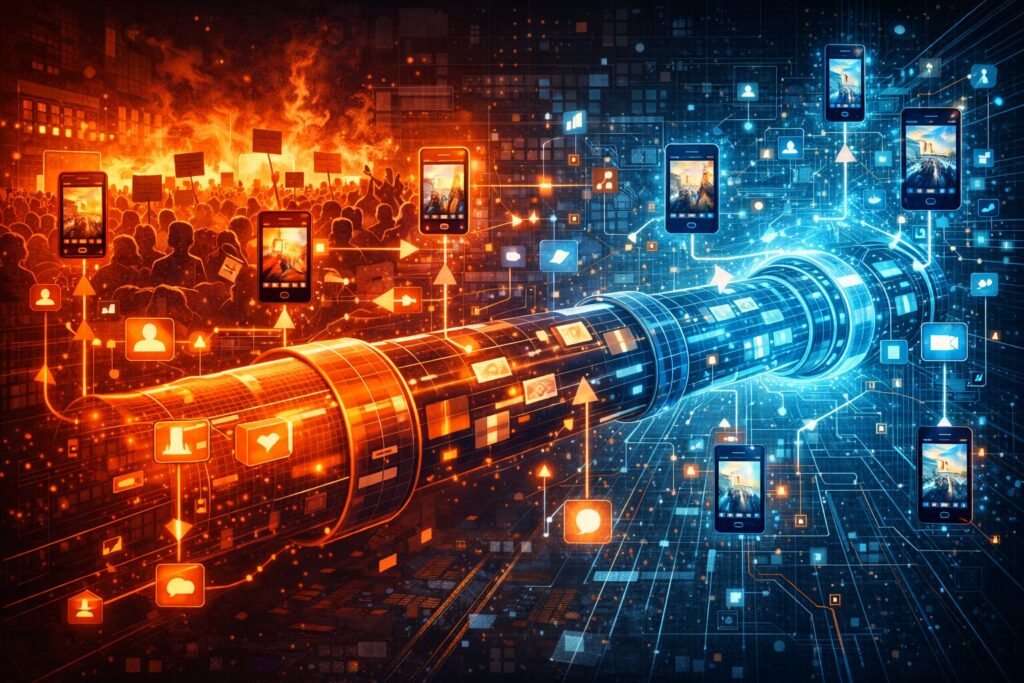
In other words: the street is an API.
People show up. Something happens. Phones capture it. The footage routes through feeds. The feeds decide what “happened.” Then the institutions respond to the version that went viral, not the version that was real.
This is not a metaphor. It’s the pipeline we’re living in.
Video doesn’t settle arguments. It relocates them.
We keep acting like video is proof, like it will close the case. But proof isn’t the thing we lack. The thing we lack is shared agreement about what proof is allowed to mean.
A video used to be evidence. Now it’s raw material.
- One clip becomes a moral indictment.
- Another becomes a justification.
- Another becomes a recruitment poster.
- Another becomes an alibi, because the angle is wrong, the context is missing, the timestamp is unclear.
The argument doesn’t end. It just upgrades.
And if you want to understand why this month feels endless, it’s because we’re watching the same loop run at full speed: capture → amplify → polarize → monetize → repeat.
The platforms are not neutral witnesses. They’re editors with a business model.
It matters what trends. It matters what gets recommended. It matters what gets taken down. It matters what gets labeled, and what doesn’t.
That’s not “censorship.” That’s distribution.
The platforms can keep insisting they’re not media companies. Fine. They’re something more intimate than that: they’re the ranking layer of society. They decide what gets attention first, what gets attention longest, and what gets attention in the specific emotional tone that keeps people locked in.
June isn’t just a protest wave. It’s a stress test for the ranking layer.
And we are learning what it values.
Policing is about legitimacy. Legitimacy is about narrative.
We talk about police violence as an enforcement problem. But at the scale we’re watching now, it’s also a legitimacy problem. Enforcement without legitimacy becomes occupation. Legitimacy without accountability becomes branding.
Here’s the uncomfortable part: legitimacy is increasingly negotiated on platforms that do not care about legitimacy. They care about engagement.
So the system keeps generating content that makes legitimacy impossible:
- The worst clips rise fastest.
- The most inflammatory claims spread farthest.
- The simplest frames win the day.
- The “maybe it’s all fake” counterframe follows immediately after.

The result is a country that cannot hold a stable picture of itself for more than a news cycle.
That instability is a form of power.
The battle over “violence” is a battle over permission
Watch how quickly the story turns into a contest over labels: peaceful vs violent, protest vs riot, reform vs abolish, order vs justice.
These labels aren’t descriptive. They’re permissions.
If you can get “riot” to stick, you can justify force.
If you can get “peaceful” to stick, you can delegitimize force.
If you can get “outside agitators” to stick, you can dismiss the message.
If you can get “state violence” to stick, you can shift the moral burden.
And because the platforms reward conflict, they reward the most extreme versions of each label.
This is why people feel like they’re yelling past each other. They are. The system is built for it.
The institutions are responding, but mostly to pressure, not principle
Yes, we’re seeing changes proposed. Reforms floated. Budgets questioned. Words said that would have been unthinkable a month ago.
But institutions don’t change because they suddenly discover morality. Institutions change when the cost of staying the same rises above the cost of adapting.
June raised the cost.
And the platforms, unintentionally, are part of how that cost is priced. Viral attention can turn a local incident into a national crisis overnight. It can also scatter focus, fragment demands, and exhaust everyone before anything concrete happens.
High heat doesn’t guarantee structural change. It guarantees motion.
Those are not the same.
The most dangerous outcome is not backlash. It’s noise.
Backlash is visible. Noise is invisible.
Noise looks like this:
- A thousand competing narratives.
- A flood of clips without context.
- Fake accounts posing as real people.
- “Both sides” distortion that flattens asymmetry.
- Constant outrage that burns attention without building power.
Noise doesn’t have to defeat a movement. It just has to prevent coherence.
If you can’t keep a shared story long enough to organize, you can’t win durable changes. You can only win moments.
June is a month of moments. The question is whether it becomes a year of structure.
We are heading into an election year where reality is a battleground
The protests are happening inside a larger frame: a pandemic, an economic shock, and an election that is already being set up as illegitimate by design.
If you think this month is intense, imagine what happens when the legitimacy crisis moves from policing to voting.
The same pipeline will apply: capture → amplify → polarize → monetize → repeat.
Only then the object won’t be a clip. It will be the outcome.
The hard truth: “What happened” is now a product
A platform can’t fix policing. A platform can’t fix inequality. A platform can’t fix a pandemic.
But platforms can shape what the public believes is happening, and how quickly that belief hardens into identity.
That is why June feels like it’s happening in two places at once: in the street, and in the feed. One is physical. One is computational. Both are real. Only one is designed to make money.
If you want to understand the power of this moment, don’t just watch the protests.
Watch the distribution.
Because the street is an API, and the country is arguing about the response payload.
Leave a Reply