February is when the year stops feeling new and starts feeling inevitable. The gym is emptier. The resolutions are quieter. The political mood, however, is still screaming.
We are six weeks into 2020 and the country already feels like it has been awake for a year.
That isn’t just because the news is heavy. It’s because the interface is heavy. The modern political experience is not a sequence of events. It is a tempo. A cadence of alerts, clips, reactions, and counter-reactions that hits your body before it hits your brain. It is politics as a reflex.
You don’t have to be deeply online to feel it. You just have to own a phone.
The argument arrives preloaded
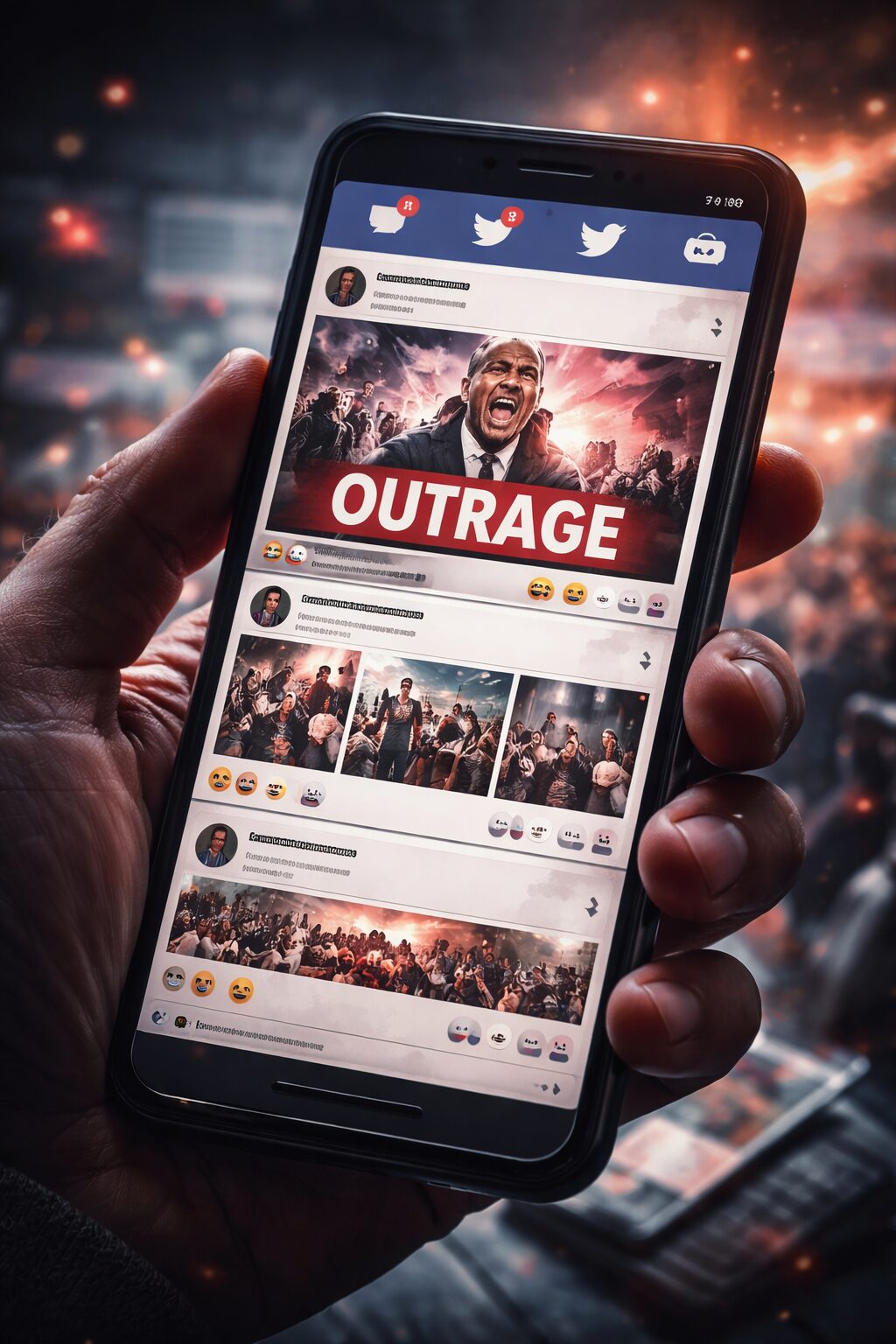
Here is the trick of the feed. It doesn’t hand you information and wait for your judgment. It hands you judgment and dares you to keep up.
A short video appears. Someone is furious. Someone else is humiliated. The caption tells you who the villain is. The comments tell you what you are allowed to say. The share button asks if you want to be a good person in public.
The story is delivered with the emotional settings already chosen.
This is why the same event can produce two entirely different realities. People aren’t just consuming different facts. They are consuming different moods. One side receives the content as a crisis. The other receives it as a joke. One receives it as proof. The other receives it as propaganda. Both are supplied with the tone they need to feel right.
And feeling right is the product.
The feed doesn’t need you to understand. It needs you to participate. Participation is measurable. Participation is profitable. Participation is a kind of vote that happens thousands of times a day.
Why politics feels like a fight even when nothing is happening
Not everything in February is a national emergency. But your screen behaves as if it is. That is the point.
The attention economy cannot tolerate normal. Normal does not trigger the thumb. Normal does not travel. Normal does not generate a comment war.
So the machine manufactures urgency. It sharpens every edge. It takes procedural politics and renders it as moral combat. It turns policy into identity. It turns disagreement into danger.
This is why so many people feel permanently threatened, even when they cannot explain by what. Their nervous system is responding to a constant simulation of conflict. They are being trained to treat every post as a test of loyalty and every silence as a failure of character.
That is not civic engagement. It is stress conditioning.
The new ritual of belonging
In older politics, belonging was built through institutions. Parties, unions, churches, community groups. Places where you met people who weren’t curated for you. Places where you had to practice patience.
In 2020, belonging is increasingly built through the feed. You join a tribe by repeating the correct phrases and sharing the correct outrage. You are rewarded for speed. You are punished for nuance. You are validated for anger, because anger signals commitment.
This is why politics now feels like a daily roll call. People aren’t just stating opinions. They are checking in. They are proving they are still part of the group.
And like any group built on performance, it becomes brittle. The line keeps moving. The purity test keeps tightening. The punishment for an imperfect sentence keeps rising. Everyone learns to speak in preapproved templates, because templates are safer than thinking out loud.
The result is a public life full of noise and short on honesty.
The two-minute hate scroll
We have built a culture where outrage is not just an emotion. It is a routine.
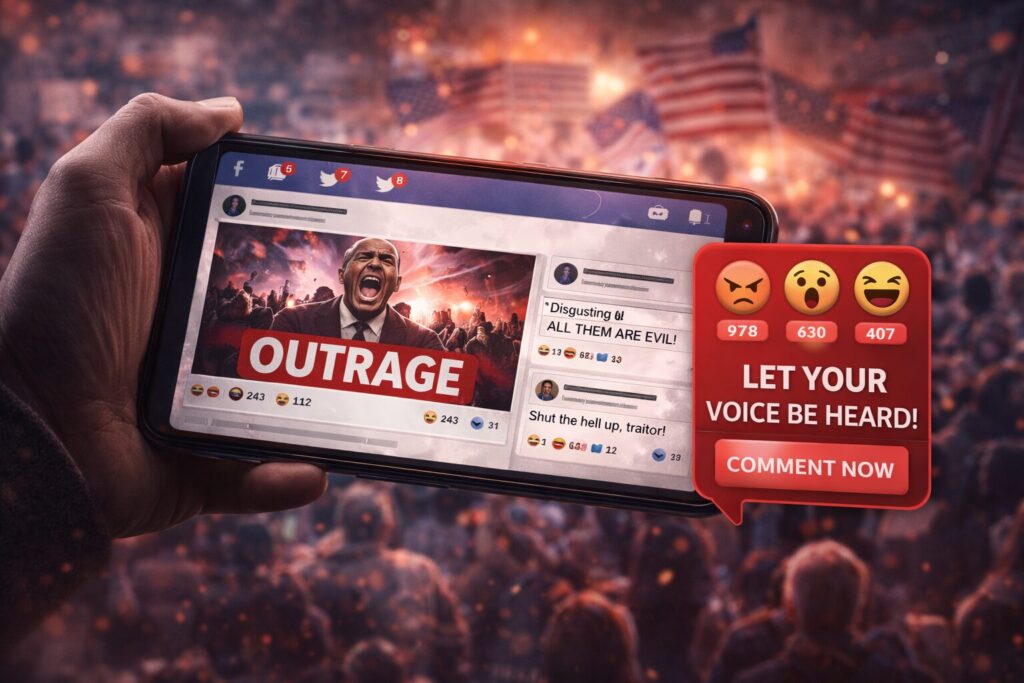
It fits neatly into spare moments. Waiting for an elevator. Standing at a crosswalk. Half-listening to a meeting. You open the phone for a second and the feed offers you a small piece of hate. Not always hate toward a person. Sometimes hate toward a group. Sometimes hate toward an idea. Sometimes just contempt, the cheap kind, the kind that feels like intelligence.
You consume it quickly. You react. You move on.
The ritual is small, but the accumulation is not. A few seconds of contempt repeated dozens of times a day changes how you see the world. It narrows your empathy. It shortens your fuse. It makes you feel certain, and certainty feels good when you are tired.
This is why the politics of 2020 feels so raw. People aren’t simply more divided. They are more trained.
The candidates are running, but the machine is campaigning
It is primary season. The candidates are selling visions. The pundits are selling narratives. The parties are selling fear.
But the most powerful campaign operation in America is the one you don’t volunteer for. It is the system that decides what you see, what you ignore, and what you feel.
It doesn’t care which candidate you support. It cares that you are engaged.
If you love a candidate, it will feed you content that makes you love them harder and hate their opponents more. If you dislike a candidate, it will feed you content that confirms your disgust. Either way, it increases the emotional stakes until your political identity feels like a personal survival mechanism.
This is why so many conversations feel impossible. You are not debating an issue. You are interrupting a feedback loop.
And feedback loops do not like being questioned.
The death of “I don’t know”
One of the quiet casualties of the feed is uncertainty.
The interface does not reward “I’m not sure.” It rewards instant certainty. It rewards hot takes. It rewards the posture of expertise. The result is that people stop admitting what they don’t know, and they start building political identities out of confident guesses.
This is dangerous, because democracy requires humility. It requires the ability to revise. It requires the willingness to discover that your side is wrong sometimes. It requires the courage to say, “I need more information,” even when your tribe is demanding a verdict.
When uncertainty becomes shameful, propaganda becomes easier.
A small experiment for February
Try an experiment. For one week, impose a two-minute rule.
You can read the news. You can even scroll. But the moment you feel the spike, the moment you feel your body tighten, the moment you feel the urge to post, to dunk, to perform, stop.
Wait two minutes.
In those two minutes, ask one question. What would I think if my side did this. Or, what would I need to know to be sure. Or, who benefits from me being angry right now.
Two minutes is not a cure. It’s a wedge. It creates space between stimulus and response. It returns a fraction of agency to your brain.
This is what the machine hates. It hates time.
What happens if we don’t
If we keep living this way, the election will not just decide a president. It will decide the baseline. It will decide what kind of emotional life we accept as normal. It will decide whether politics is a periodic civic responsibility or a constant psychological occupation.
The feed will keep offering you certainty. It will keep offering you villains. It will keep offering you the two-minute hate scroll, because it is easy and it works.
The question is whether you will keep taking it.
Because the most powerful political force in February 2020 is not the candidates on stage.
It is the daily ritual in your pocket.
Leave a Reply