If you want to understand American politics in 2019, stop imagining a town hall. Start imagining a group chat with 330 million people, zero moderators, and a “typing…” bubble that never goes away.
That is where we live now.
Not in a republic of calm deliberation, not in a marketplace of ideas, but in a rolling, endless feed where every event is immediately repackaged into a personality test. If you react correctly, your team applauds. If you hesitate, your team suspects you. If you ask a question that takes longer than a tweet to answer, someone helpfully informs you that you are either naive, complicit, or both.
This is not a crisis of intelligence. It is a crisis of incentives.

Politics used to compete with sports, work, and family for your attention. Now it competes with nothing because it has become the method by which you understand sports, work, and family. Your boss’s email has a partisan aura. Your cousin’s wedding invitation has an ideological subtext. Even your dentist’s waiting room television seems to be taking sides. In 2019, the only neutral setting is airplane mode.
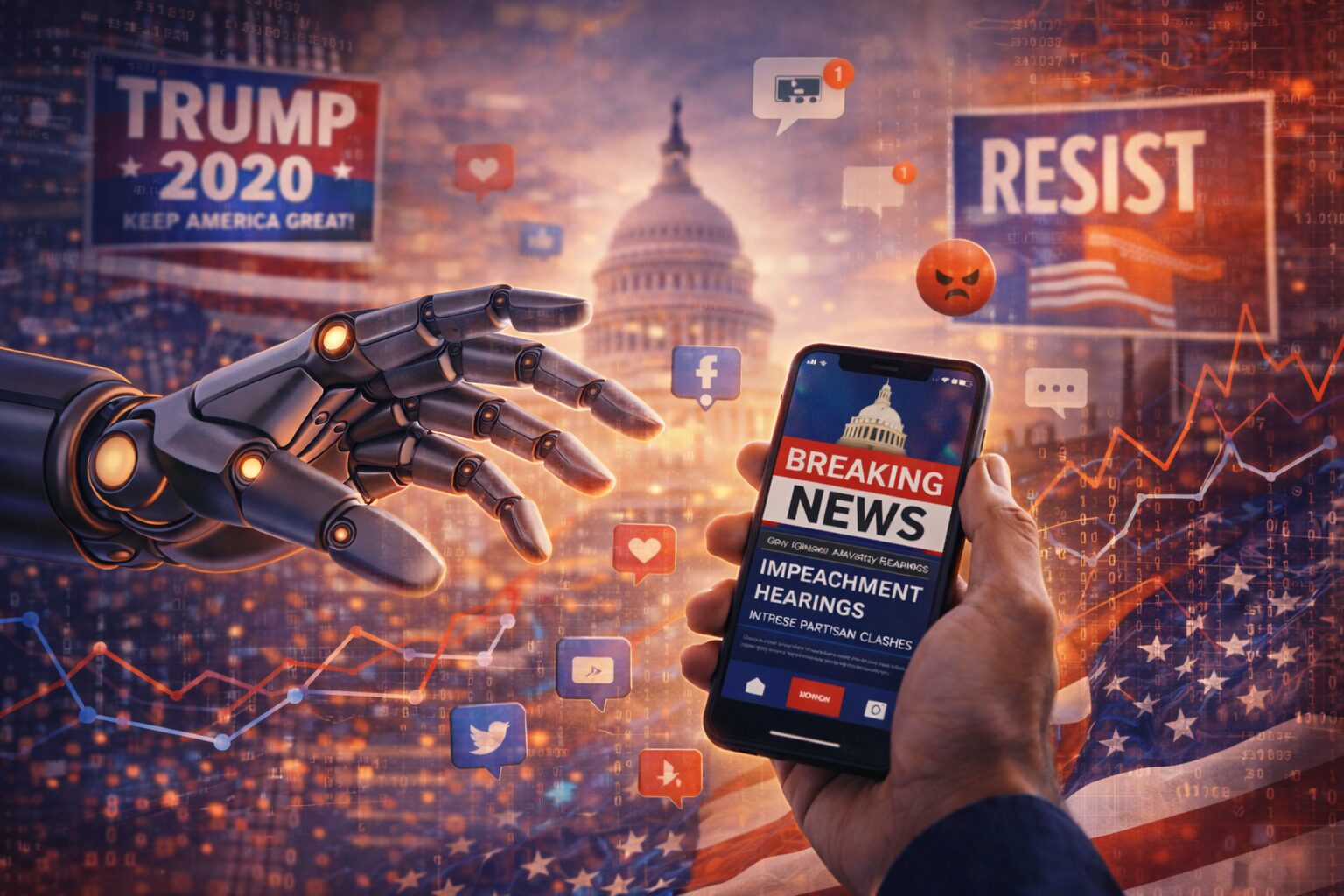
Impeachment is the plot. The feed is the setting.
Yes, the country is watching impeachment hearings. Yes, people are arguing over what matters, what counts as evidence, what qualifies as “normal,” and what qualifies as “too far.” You can tell a lot about someone’s political loyalties by the way they pronounce the word “impeachment,” the way they roll it around like a marble they already decided to swallow or spit out.
But here’s what feels different this time. It is not just the content of the conflict. It is how the conflict moves.
Every moment is clipped, captioned, and shipped. Someone says something serious, and before you can consider it, it has already been converted into a slogan for one side and a punchline for the other. Entire constitutional arguments get processed like snack food. Salted. Packaged. Designed to be consumed quickly and forgotten faster.
You do not have to be a political junkie anymore. Politics will find you. It arrives as a notification. It arrives as a coworker’s smirk. It arrives as a “just asking questions” meme on Facebook. It arrives as an uncle’s ominous YouTube link.
In the old days, a scandal might have unfolded over weeks, giving people time to think, argue, and absorb. In 2019, a scandal unfolds over minutes, and by the time you’ve read the first article, the internet is already yelling about the third.
Everyone thinks they are resisting something
One of the strangest features of this era is that nearly everyone sees themselves as the underdog.
On the right, you hear a story about elites, bureaucrats, coastal media, and shadowy institutions that cannot accept the election result, so they are trying to reverse it by any means necessary. On the left, you hear a story about authoritarian drift, corruption, contempt for norms, and the slow conversion of government into a personal protection racket.

Two narratives. Two sets of villains. Two sets of heroes. Same emotional structure.
Each side believes it is defending “the real America” from an enemy that is both incompetent and terrifying, both ridiculous and omnipotent. Each side believes the other side is acting in bad faith. Each side has receipts, usually in the form of screenshots.
And because each side believes the stakes are apocalyptic, each side becomes willing to excuse behavior it would never tolerate from the other. You can watch this happen in real time.
When your side bends a rule, it is strategy.
When their side bends a rule, it is tyranny.
When your side lies, it is messaging.
When their side lies, it is the collapse of civilization.
You do not need a conspiracy to explain this. You only need adrenaline.
The 2020 race is a mood ring
The 2020 election is less a contest of policies than a referendum on the country’s emotional weather.
Democrats are sorting themselves into familiar tribes. Some want a candidate who will restore competence and calm, like someone hired to clean the carpets after a house party that got out of hand. Some want a candidate who will kick down the walls and rebuild, because the house was rotten anyway. Some want both, which is like asking for an ambulance that also installs a new kitchen.
Republicans, meanwhile, have mostly made their peace with a style of politics that treats conflict as proof of strength. For many, the chaos is not a bug. It is the point. A leader who annoys the right people is considered effective by definition.
This creates a weird mismatch. One side argues about plans. The other side argues about enemies. Plans are slow. Enemies are fast. Plans require patience. Enemies require loyalty.
So we get a campaign season where everyone says “unity” and then immediately explains why the other side is fundamentally corrupt, stupid, and dangerous. We are a nation holding hands while reaching for the nearest rock.
The press is both necessary and impossible
In 2019, Americans have two simultaneous beliefs about the media.
First, we believe journalism is essential. We want someone to dig, verify, expose, and explain. We want accountability. We want sunlight.
Second, we believe the media is infected by bias, incentives, and theater. We suspect ratings. We suspect clicks. We suspect that “breaking news” means “breaking your attention span.”
Both beliefs can be true.
The problem is not that everyone is lying. The problem is that everyone is optimizing.
Cable news optimizes for conflict. Social media optimizes for engagement. Politicians optimize for viral moments. Activists optimize for outrage. Even regular citizens optimize for social approval, which is why your political identity is now a wardrobe. You do not just think things. You wear them.
When the whole system rewards heat, light becomes a niche product.
The real scandal is what it does to us
Here’s the part no one wants to admit. The damage is not confined to Washington.
This era is rewiring our basic social skills.
We are losing the ability to disagree without treating it as a moral emergency. We are losing the habit of assuming good faith. We are losing the muscle memory of restraint.
We used to have a cultural understanding that you could hold a political position and still be a human being worth knowing. Now, many people treat politics as a complete personality scan. One issue, one vote, one phrase, and you are categorized permanently. Friend. Enemy. Traitor. Idiot. Monster.
Once you adopt that mindset, persuasion becomes pointless. If the other side is evil, why talk? If the other side is stupid, why listen? If the other side is beyond redemption, why share a country?
This is how democracies get brittle, not in a single coup, but in a thousand small divorces.
A modest proposal, by which I mean a practical one
If you want to survive American politics in 2019 without turning into a full time rage machine, you need rules. Not for the country. For yourself.
- Delay your certainty.
If a story makes you feel instantly righteous, pause. That emotional jolt is not proof. It is bait. - Criticize your own side in public.
Not for balance. For credibility. If you cannot admit your team’s failures, you are not thinking, you are cheering. - Choose one primary source a week.
Read a transcript. Watch a full hearing segment. Look at the actual report. It will not be fun. It will, however, be real. - Stop sharing things that you did not read.
If you share headlines like baseball cards, you are part of the machine. You are not informing anyone, you are recruiting. - Talk to one person you disagree with, offline.
Not to win. Not to dunk. To practice being a citizen again.
None of this fixes Washington. But it might fix the part of the country you actually control, the part between your ears.
The question we keep dodging
The loudest argument in 2019 is about who is right.
The more important argument is about what we are becoming.
Are we a society that can handle disagreement without imploding? Are we a country where politics is a tool for solving problems, or is it a permanent reality show designed to keep us agitated and profitable? Are we still capable of sharing institutions with people we cannot stand?
Because impeachment will end. The primaries will end. The election will end. One way or another, the feed will move on.
What will not end, unless we choose to change it, is the habit of treating politics as a daily moral cage match.
In 2019, the algorithm is not just describing American politics.
It is shaping it.
And if we keep rewarding the worst version of ourselves, we should not be surprised when that is what wins.
Leave a Reply